Active Reading
Outcome III (Active Reading) – Employ techniques of active reading, critical reading, and informal reading response for inquiry, learning, and thinking. This learning outcome focuses on active reading and a range of informal writing activities that develop understanding and enable us to engage meaningfully with what we read.
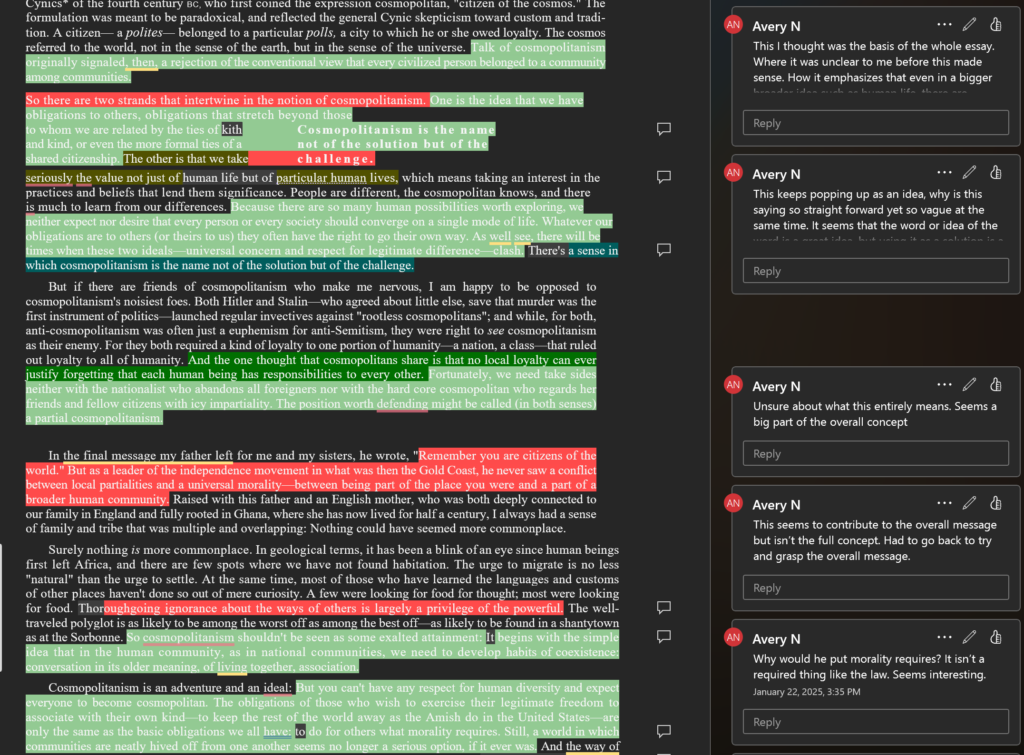
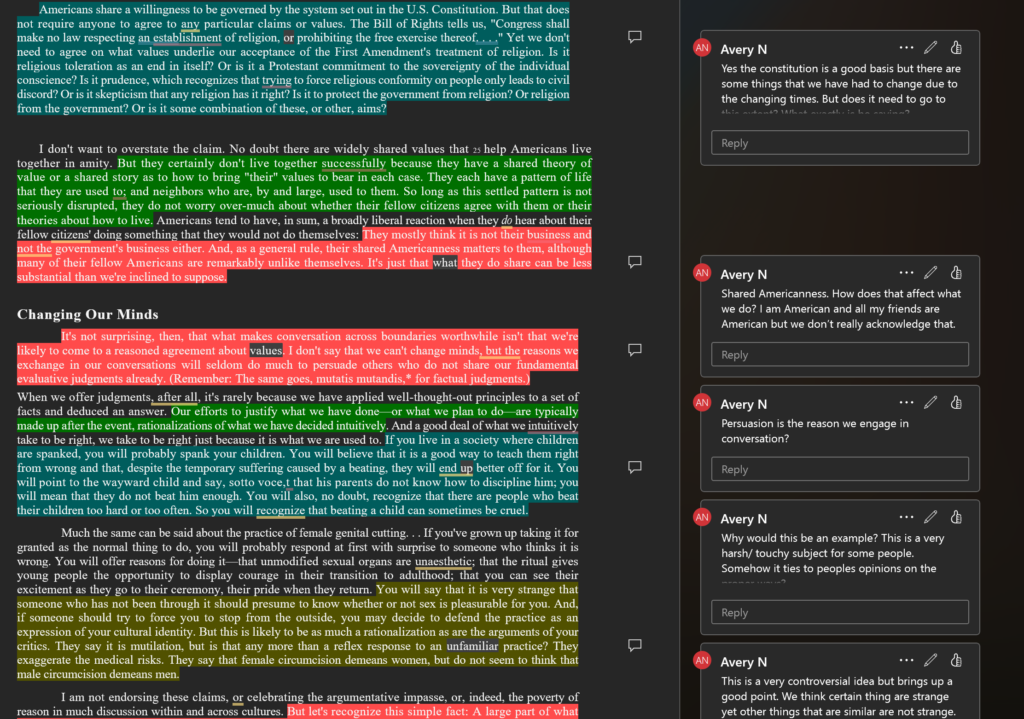
For this English 110 class I read an essay by Anthony Kwame Appiah titled “Making Conversation and The Primacy of Practice”. As I was reading this, I made annotations when I had questions, made connections, and had a moment where I felt that I really understood the text. After making these annotations, I explained why I thought that the highlighted section was relevant, allowing me to practice and grow my skills for reading and analyzing important texts, which can greatly help me in other classes. Understanding is shown in red, questioning is shown in blue, relating is shown in green, and challenging is shown in orange.
Understanding – Where are you annotating to understand the reading? Where are your reading responses working to aid understanding? Be specific.
In paragraph 3, Appiah states, “the possibilities of good and of ill are multiplied beyond all measure when it comes to policies carried out by governments in our name. Together, we can ruin poor farmers by dumping our subsidized grain into their markets, cripple industries by punitive tariffs, deliver weapons that will kill thousands upon thousands”. This shows that people have the choice and ability to make change, whether good or bad, that this power is amplified by those that run our country, and have the ability to cause an immense amount of damage if we choose to.
Questioning – Where are you annotating to ask questions or figure out things in the text? How did you sort that out over the project? Be specific.
In paragraph 13, Appiah says “[w]ho but someone in a grip of a terrible theory would want to insist on an agreement on principles before discussing which movie to go to, what to have for dinner, when to go to bed?”. I think that he has a good point, maybe I am interpreting it wrong but it seems that he tries to get the point that someone who is truly held on their beliefs and wants to fight for those beliefs is not going to argue over something that seems meaningless, but as soon as its a political or controversial issue, people will argue till they win or are satisfied.
Relating – Where are you making connections between the texts, or between the texts and your essay? Include annotations where we see that.
In paragraph 10 , Appiah says “[i]n the wake of 9/11, there has been a lot of fretful discussion about the divide between “us” and “them.” What’s often taken for granted is a picture of a world in which conflicts arise, ultimately, from conflicts between values. This is what we take to be good; that is what they take to be good. That picture of the world has deep philosophical roots; it is thoughtful, well worked out, plausible”. Despite not being alive for 9/11, I have looked back at the media and heard stories about that day and realized that it was a basis of conflicting values. It was to send a message to the United States against our values that our nation idealizes. Just looking at the motive for this event puts things in perspective of how powerful values and ideals are and the lengths people will go to protect those values.
Challenging or Extending – Where are you challenging ideas in the texts? Where are you extending an author’s idea or ideas? Show this in annotations, in homework responses, or in other evidence of your active reading work.
In paragraph 3, Appiah states “together we can raise standards of living by adopting new policies on trade and aid, prevent or treat diseases with vaccines and pharmaceuticals, take measures against global climate change, encourage resistance to tyranny and a concern for the worth of each human life”. While this seems like the ideal situation, it’s a lot harder to say than do. Yes we can do things such as prevent diseases, find solutions towards climate change, etc., but there will always be forces going against that. Not everyone is going to agree. There are people who do not believe in taking vaccines, there are people who don’t believe in climate change, or have problems with some solutions. Many people are not concerned with everyone. Many people live in their own little bubble, their own world. It’s hard for people to sometimes see beyond themselves.
Down below are two screenshots of the active reading, along with the color codes and comments.